A workspot is a GNU/Linux account, on our servers. You use the desktop and software through a web browser, from anywhere in the world.
Monday, January 27, 2003
Document 27
In a project known as “Acoustic Kitty” the Directorate of Science and Technology sought to train a surgically altered cat, wired with transmitting and control devices, to become a mobile, eavesdropping platform. In its first test, the cat was run over by a taxi. According to Victor Marchetti:
They took it out to a park bench and said “Listen to those two guys. Don’t listen to anything else – not the birds, no cat or dog – just those two guys!” ... They put him out of the van, and a taxi comes and runs him over. There they were, sitting in the van with all those dials, and the cat was dead!
Tuesday, January 21, 2003
Streaming videos of data presentation and interaction ideas we take for granted
"On December 9, 1968, Douglas C. Engelbart and the group of 17 researchers working with him in the Augmentation Research Center at Stanford Research Institute in Menlo Park, CA, presented a 90-minute live public demonstration of the online system, NLS, they had been working on since 1962. The public presentation was a session in the of the Fall Joint Computer Conference held at the Convention Center in San Francisco, and it was attended by about 1,000 computer professionals. This was the public debut of the computer mouse. But the mouse was only one of many innovations demonstrated that day, including hypertext, object addressing and dynamic file linking, as well as shared-screen collaboration involving two persons at different sites communicating over a network with audio and video interface."
Thursday, January 16, 2003
Easter Island:
"...there's a lot more to this story than meets the eye. Not just the thousands of miles these people must have covered to reach the island, but a story of ecological disaster, starvation, cannibalism, and disease."
"Bug Study May Give Wings to Re-evolution Theory"
"Brigham Young University researchers have uncovered genetic evidence in stick insects -- a group of bugs that resemble tree twigs with legs -- that could force scientists to rethink long-held beliefs involving a part of the theory of evolution. "
"By analyzing the DNA sequences of the walking stick, Maxwell and Whiting found that members of a certain group of these insects lost the ability to fly and then re-evolved it 50 million years later."
"We're fortunate because of the story, and we had a picture of a sexy little bug," Maxwell said. "One reason we're on the cover is because we had pictures of lots of sexy little bugs."
via mefi
Tuesday, January 14, 2003
Einstein to Roosevelt, August 2, 1939
"Leo Szilard was profoundly disturbed by the lack of American action. If atomic bombs were possible, as he believed they were, Nazi Germany might gain an unbeatable lead in developing them. It was especially troubling that Germany had stopped the sale of uranium ore from occupied Czechoslovakia.
Unable to find official support, and unable to convince Enrico Fermi of the need to continue experiments, Szilard turned to his old friend Albert Einstein..."
How I learned to Stop Worrying and Love the Bomb
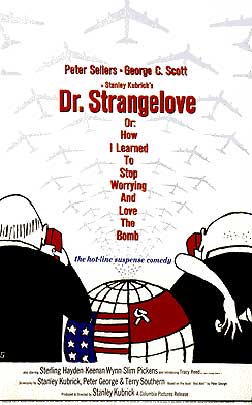
I found these links to Historical Nuclear Weapons Test Films a while ago, but for some reason lost track and forgot about them. From the Nevada Site Office of the U.S. Department of Energy National Nuclear Security Administration, they also have some other video clips that I will soon take a look at. Finding the site again reminds me of both Dr. Strangelove and the serious novel and film that tackles the same issues, Failsafe by Eugene Burdick and Harvey Wheeler.
Sidenote:
It also seems to me that our current administration is using antiquated cold war strategies to combat terrorism. Once we had to build more weapons to make sure that we were superior. Now we have the most weapons, so all we have left to do is take away weapons from other people. Mind you, I'm not troubled with the idea of removing weapons from the hands of any person, except that we are holding on to our own. I guess it's implied that eventually, once we've taken everyone else's weapons the world will be safe (safe from us?), there will be no need for weapons, but I have trouble envisioning a U.S. that will want to give up such total control. We've truly taken a lesson from Rome, divide and conquer. I just hope we don't all die of lead poisoning. Ah ha! Perhaps this explains our government's somewhat irrational abolitionist and mechanistic drug laws. Further evidence that suggests we will repeat the mistakes of Rome (we've made enough already). Then again I guess some would argue that some of the success attributed to the Romans were actually failures.
Saturday, January 11, 2003
Thursday, January 09, 2003
Subscribe to:
Posts (Atom)